


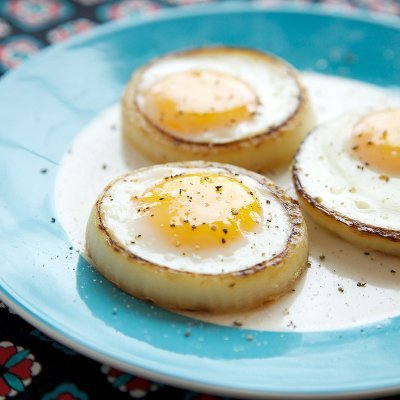
Onions are a staple in most kitchens, valued for their flavor and aroma but they can also play a surprisingly creative role in how food is prepared and presented. One clever and increasingly popular technique is using onion rings as natural molds, especially for breakfast dishes.
To try this method, start by slicing onions into wide, հաստ rings and separating the layers. The larger outer rings work best, as they provide enough space to hold fillings without spilling. Place three or four of these rings into a buttered frying pan over high heat. Let them cook briefly, then flip them to allow the edges to caramelize, bringing out the onion’s natural sweetness.
Once the rings are nicely browned, reduce the heat and crack an egg directly into the center of each ring. The onion acts as a barrier, keeping the eggs neatly contained and preventing them from spreading across the pan. The result is a set of perfectly round fried eggs, each infused with a hint of onion flavor.
For best results, the onion slices should be thick enough to hold their shape. At the start, you may need to gently press them down with a spatula to ensure the egg doesn’t leak underneath. As the eggs cook, you can enhance them by adding small touches fresh herbs, shredded cheese, or other garnishes directly into the ring.
Covering the pan with a lid for the final 15 to 20 seconds helps achieve a perfect sunny-side-up finish, with fully set whites and a soft yolk. Once done, the eggs can be served either inside the onion rings or removed, depending on presentation preference.
This technique pairs well with toasted muffins or bagels, and can be elevated further with toppings like hollandaise sauce, hot sauce, or fresh salsa. Whether served open-faced to highlight the clean, round shape of the eggs, or assembled into a sandwich, the dish is both visually appealing and flavorful.
Interestingly, this onion-ring method isn’t limited to the stovetop. It can also be adapted for outdoor grilling, making it a great option for burgers topped with eggs or other creative combinations. In this way, a simple onion becomes more than just an ingredient – it becomes a practical and edible cooking tool.